What we do.
Roots gives growers and their customers a system to measure, improve and get paid for the environmental footprint of food production - built on independent science and a chain of trust that runs from field to buyer.
Roots gives growers and their customers a system to measure, improve and get paid for the environmental footprint of food production - built on independent science and a chain of trust that runs from field to buyer.
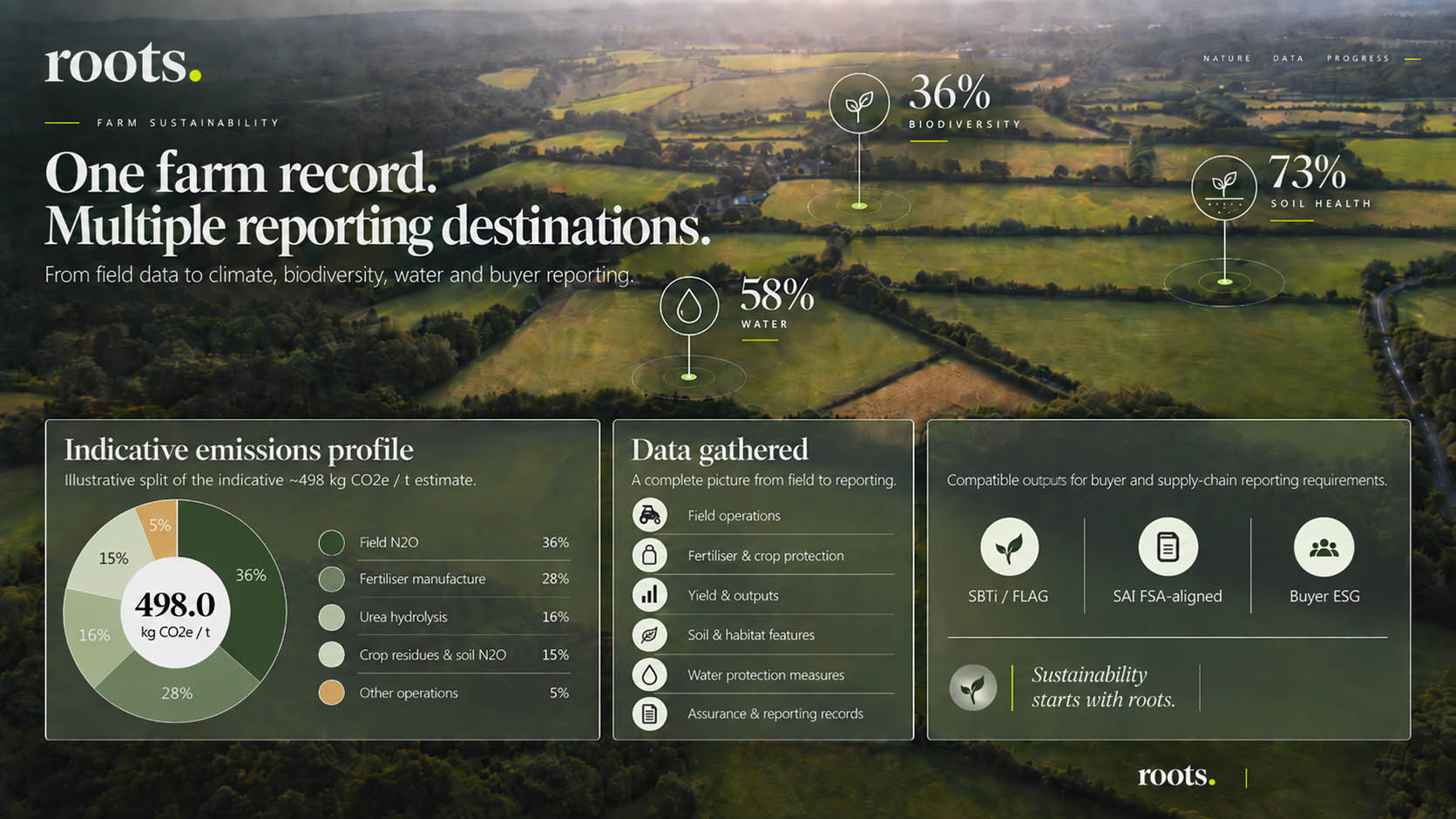
One platform. A grower enters their farm information once, and it becomes whatever each part of the supply chain needs - carbon, soil, water, biodiversity and SAI-aligned reporting, all from the same data.
Built with growers, merchants, buyers and independent scientists rather than for them. Every number in it can be traced to the field it came from, and every carbon figure passes through five layers of verification, finishing with independent review.
The reporting rules for food and farming have changed, and they've changed in the right direction. The new standards reward buyers who can trace what they buy back to the farm, and only count carbon removals that are measured on the ground. That's what Roots One was built for.
Measuring a farm's existing footprint matters, but it only tells part of the story. Real change comes from improvement, and improvement is what the market is learning to recognise. Our focus is on showing the additional benefit growers are creating each season - not just tallying what was already there.
Because every farm in the system is measured the same way, growers can see where they sit against comparable farms - same crop, same soil type, same region - and buyers can see the spread across their supply. Benchmarking isn't a league table. It's how a grower knows which changes are worth making, and how a buyer knows where progress is possible.
Our approach is tailored to each user. We educate rather than overwhelm. The science underneath is more rigorous than most, but the grower shouldn't have to feel it.
To date, Roots has helped farmers and merchants on over £3.5 million of higher-value grain contracts - working through the existing trade, not around it.
Farm-level production emissions for your Scope 3 inventory, with the CO₂ and non-CO₂ split that FLAG targets need. Reported per tonne and per hectare, traceable to the field, and shaped to sit straight into an SBTi FLAG submission or a Land Sector and Removals inventory.
Farm data collected against the questions behind the SAI Platform's Farm Sustainability Assessment, across all its impact areas. Roots collects and evidences; it doesn't issue an FSA level.
Progress, not just a snapshot. Year-on-year improvement in carbon, soil, water and biodiversity across the farms in your supply chain - the story your sustainability report actually needs, with the evidence behind it.
One report structure across every crop and every grower you trade with, so you can offer verified, higher-value contracts without building a data team. Roots works alongside the merchant, never around them.
Your own farm's picture: where the emissions sit, what's already being stored, and what's moving year to year. Written in plain English, and yours to share with whoever you choose.
get in touchRoots Carbon has developed a methodology for high-integrity carbon removals - measured on farm, monitored over time so that stored carbon stays counted, and independently reviewed. It's built to meet the standard the new rules set: primary data, traceable to the field, and never blended with emissions. First verified tonnes are the next step.

Carbon is where the rules are, but it's not where the whole benefit is. Roots One reports on soil, water and biodiversity alongside it, so that a farm's improvements show up as the improvements they are - not as a line lost in someone else's spreadsheet.Each one is measured as a trend, not a snapshot, reported in plain terms with the evidence behind it, and lined up with the impact areas the main sustainability frameworks are built around.
The best progress happens when science and farming work side by side. We work with independent researchers and forward-thinking growers to refine how environmental data is gathered, verified and shared - from field level, up to the reporting a national supply chain needs. The goal is data that growers trust, buyers can rely on, and nobody has to take on faith.